Deciphering dynamic thrombus formation from high-content low-contrast images under flow
Project details
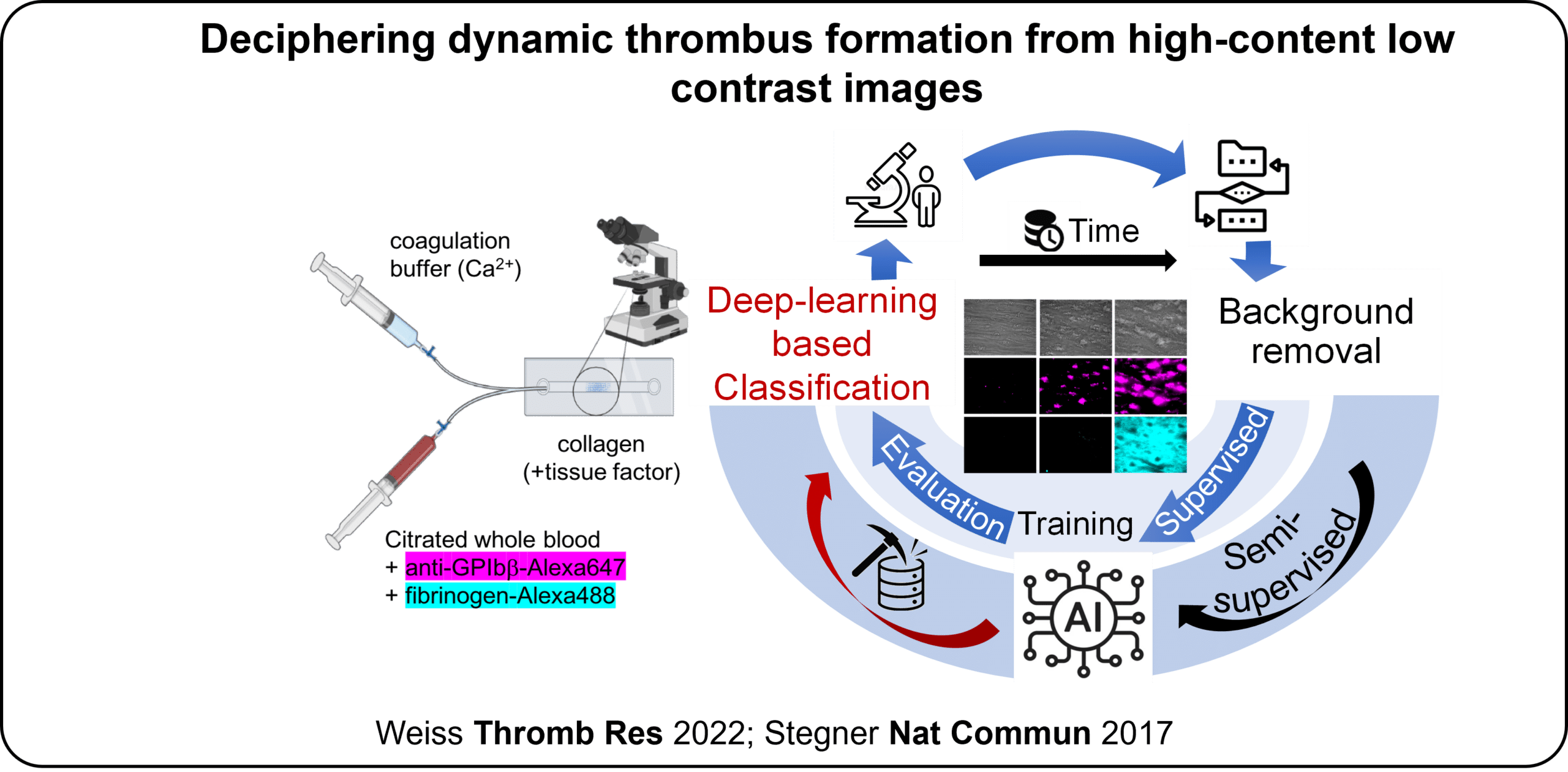
Thrombus formation is a complex process including platelet adhesion to matrix proteins like collagen, thrombus growth due to platelet-platelet and platelet-leukocyte interactions and finally thrombus resolution in response to fibrinolytic activity. Microfluidic devices like (coagulation) flow chambers allow to study this process over time, but bright field light microscopy provides images with an overall poor contrast. Fluorophore-labeled antibodies against cellular components (platelet surface receptors) or fibrinogen allow immunofluorescence images to complement the bright field microscopy. Nevertheless, quantification of these images is labour-intensive and strongly user-based. Machine-based learning approaches allow to elucidate the low-contrast high-content images not only to replace and standardize the image analysis, but allows also to disclose yet unknown parameters accompanying platelet adhesion, aggregation and thrombus resolution.
Project P08 aims to develop imaging pipelines to study thrombus formation under inflammatory conditions. Immunothrombosis is for example a hallmark of sepsis and usually investigated in flow chamber-based assays, however often limited by low-contrast high-content images. Since scoring of these images is challenging, Harald Schulze and Katrin Heinze will explore machine-learning and deep-learning tools to classify and quantify such immunothrombotic events with minimized bias.
ECR.P08.11 Scoring thrombus formation from high-content low-contrast images under flow by artificial intelligence-based image analysis
– will (i) analyze and score already acquired datasets from genetically modified mouse strains and from patients with sepsis and COVID-19 compared to healthy controls by machine-based algorithms (ii) will further explore imaging pipelines supported by supervised and (semi)-supervised algorithms to decipher yet unknown parameters that accompany thrombus initiation, growth, stability and resolution.
References
Stegner, D.; vanEeuwijk, J. M. M.; Angay, O.; Gorelashvili, M. G.; Semeniak, D.; Pinnecker, J.; Schmithausen, P.; Meyer, I.; Friedrich, M.; Dütting, S.; Brede, C.; Beilhack, A.; Schulze, H.; Nieswandt, B.; Heinze K. G. (2017) Thrombopoiesis is spatially regulated by the bone marrow vasculature. Nature Communication, 8 (1), 127. https://doi.org/10.1038/s41467-017-00201-7
Weiss LJ, Manukjan G, Pflug A, Winter N, Weigel M, Nagler N, Kredel M, Lam TT, Nieswandt B, Weismann D, and Schulze H (2021). Acquired platelet GPVI receptor dysfunction in critically ill patients with sepsis. Blood 137, 3105-3115. doi: 10.1182/blood.2020009774
Weiss LJ, Drayss M, Mott K, Droste M, Just B, Arold AM, Nieswandt B, Weismann D, Stegner D, and Schulze H (2022). The homophilic CD84 receptor is upregulated on platelets in COVID-19 and sepsis. Thromb Res 220, 121-124. doi: 10.1016/j.thromres.2022.10.011
Weiss LJ, Drayss M, Manukjan G, Zeitlhofler M, Kleiss J, Weigel M, Herrmann J, Mott K, Beck S, Burkard P, Lam TT, Althaus K, Bakchoul T, Frantz S, Meybohm P, Nieswandt B, Weismann, D, and Schulze H (2023). Uncoupling of platelet granule release and integrin activation suggests GPIIb/IIIa as a therapeutic target in COVID-19. Blood Adv 7, 2324-2338. doi: 10.1182/bloodadvances.2022008666
Beck S, Öftering P, Li R, Hemmen K, Nagy M, Wang Y, Zarpellon A, Schuhmann MK, Stoll G, Ruggeri ZM, Heinze KG, Heemskerk JWM, Ruf W, Stegner D, Nieswandt B. (2023) Platelet glycoprotein V spatio-temporally controls fibrin formation. Nat Cardiovasc Res. 2023 Apr;2(4):368-382.
Desirable student skills
ECR.P08.11: Experience with cell biology and cell culture. Knowledge of machine-learning approaches and biological imaging.